


The amount of damage it could do depends on your laser. And your camera.
Opening a door with a hairpin is a common cliché in books, movies and video games. If you are a fan of Better Call Saul, you might have seen a different way of escaping a more technologically advanced capture. In the episode called “Wiedersehen” (Season Four Episode Nine), Werner Ziegler uses a laser pointer to blind a security camera. His escape is only discovered when Mike Ehrmantraut notices some dead pixels on the monitor feeds and finds the pointer. Only it was too late, and Ziegler had already escaped. The trick is clever — but does this work in real life? Well, kind of.
Laser pointers can blind security cameras. In some cases, they can even damage them permanently. However, this would require a combination of three things: a very powerful laser, an older camera and an extremely steady pulse. Possible, but difficult. In most places, it is also illegal. In 2021, a Clearwater man got arrested for pointing a laser at several surveillance cameras owned by the Church of Scientology. The laser did not destroy the cameras, but it did leave dead spots on their lenses, resulting in over $2,000 in damages. Still, the cameras were able to catch him red-handed.
What effect does a laser have on a security camera?
Lasers emit concentrated beams of light at a high intensity. Cameras, meanwhile, are built to convert light into electrical charges, which are then processed and turned into digital video frames. For this reason, security cameras are more susceptible to strong lights than the human eye. Often, exposure to intense light sources such as bright headlights or sunlight reflections can cause the lens to be overwhelmed with light, leading to glare or temporary whiteout effects in footage. Laser pointers can create a similar effect, but stronger.
Most CCTV cameras use either complementary metal-oxide semiconductor (CMOS) or charge-coupled device (CCD) sensors, which can be targeted directly by laser pointers for a sustained period of time. The laser would overwhelm the camera sensor, temporarily blinding it. Moreover, high-intensity lasers also produce heat. Prolonged exposure to this would result in dead pixels and dark spots in the resulting image. In the worst cases, larger “dead areas” would leave the camera unusable.
Modern cameras are more laser-resistant
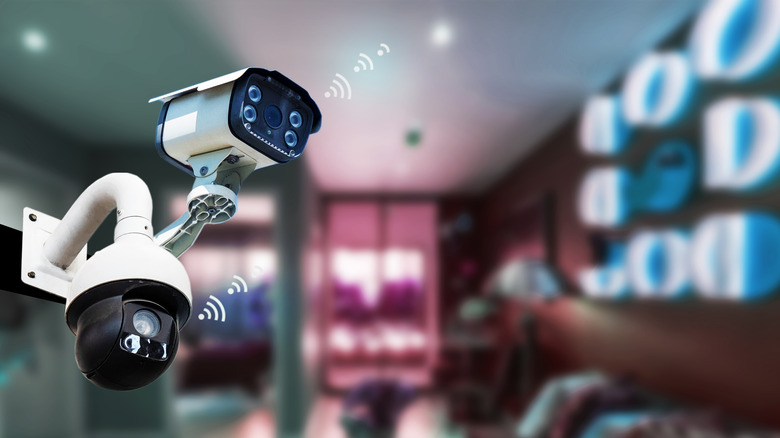 CHALERMPHON SRISANG/Shutterstock
Not all lasers can actually damage a camera. It would only be possible with a high-powered laser held still for about 10 seconds. If a laser has an output power under 5mW, it is unlikely to cause anything more than a temporary glare on the camera. The problem? Under US Food and Drug Administration regulations, handheld laser pointers that exceed 5mW of output power are illegal to market, sell or promote. For this reason, anyone with a laser that could actually damage a camera is likely to face larger problems than the damage done to the lens.
Let’s say that someone had access to a high-powered laser and pointed it directly at a security camera. Even then, it would be difficult for them to cause real long-term damage. As it turns out, it is not easy to hold one’s hand steady and aim straight at a camera lens from a distance for a long time. When researchers at IPVM tried using a laser to blind a security camera, they found it “very difficult” to keep the laser focused on an object from roughly 5 feet away “without their hands shaking off target.” At this distance, the team could not cause any permanent damage to the security cameras, regardless of the strength of the laser used.
Even with a high-powered laser and good aim, damaging a modern camera would still be difficult, due to newer technology and sensor protections. Vince Gilligan, co-creator of Better Call Saul, even admitted on a podcast that Ziegler’s trick would only work on a camera model from the 1960s.
How to prevent (and address) laser damage in your camera
It is impossible to make a standard home security camera completely laser-proof. However, there are preventative measures that can be taken to protect security cameras and make damaging them more difficult. The key is access.
To laser-proof a camera, the simplest solution is to keep it somewhere high or at an angle. This would make it difficult for anyone to aim at it for a prolonged period, as the IPVM team found. Moving security cameras are also harder to aim at. Additionally, using several cameras to cover the same area increases protection. Overlapping coverage would ensure that there are no blind spots, even if one of the cameras is damaged. Finally, many modern cameras allow the installation of security systems that can detect sudden changes in light or unusual activity. This way, if a camera view is blocked or hit with a bright beam, the system can send an instant phone alert.

